
How to access the Balancing Mechanism as an Embedded Generator
Balancing Mechanism (BM) access options for embedded generators
The option you choose to access the BM directly affects how quickly you can get to market. This page helps you:
- Understand the BM access option available to embedded projects
- Understand the process, requirements, and timescales for each option
- Make an informed BM access option decision based on your business needs
- Prepare and avoid common delays
- Progress efficiently through the selected option process
A simple guide to your BM participation options, what’s required and how to get to market faster. If you generate electricity, you can access the Balancing Mechanism (BM) in different ways.
Step 1: Connect and export electricity
Before you can participate in the BM, your asset must be able to export electricity, this typically includes:
- A connection agreement from your Distribution Network Operator (DNO)
- A Statement of Works or transmission assessment (if required)
- An Embedded Agreement (BEGA for direct market access) connection agreement
- G99 compliance
- Commissioning
Important: Being connected does not mean you can participate in the Balancing Mechanism.
Step 2: Chose your option to Market
There are three main options to access the Balancing Mechanism:
Option 1: Participate directly (BEGA) - You participate in the BM yourself, best if you:
- Need Transmission Entry Capacity (TEC)
- Want direct control trading capability
- Must meet full Grid code compliance and operational requirements (higher complexity)
Option 2: Third Party (Supplier / BELLA) - Another organisation participates on your behalf, best if you:
- Do not need a TEC
- Prefer to manage BM participation
- Want a simpler operational model
Option 3: Aggregator / Virtual Lead Party (VLP) - A flexibility provider represents your asset in the market, best if you:
- Want the simplest option
- Have smaller or less complex assets
- Prefer optimisation and trading managed externally
Step 3: Applying for a BEGA
A BEGA enables eligible embedded generating units to participate directly in the Balancing Mechanism. Your connection agreement allows your generating unit to connect to and export onto the electricity network. A BEGA establishes the additional commercial and operational arrangements required for direct participation in the Balancing Mechanism.
Before you apply
You should notify your DNO that you intend to apply for a BEGA. If you are applying for a new connection and require a BEGA, please refer to the Connections Offer Process guidance.
If you have an existing connection offer, or a connected asset that you now wish to participate directly in the Balancing Mechanism, you can submit a BEGA application through the Connections Portal. Before submitting your application, you should be prepared to provide information about your project or asset, including:
- project capacity (MW)
- technology type (for example, wind, solar, battery or hydro)
- connection location
- expected connection or energisation date
- relevant technical information relating to your generating unit and connection
- confirmation of whether any changes are being requested to your existing connection arrangements
What happens next?
NESO will review your application to confirm that it is complete and contains the information needed to begin the onboarding process.
Where required, NESO will coordinate with the relevant network company as part of progressing your application. The activities required will depend on the characteristics of your project and the information already available. Wherever possible, existing connection approvals and technical information will be used to support the process and minimise unnecessary duplication.
Following acceptance of a competent application, NESO will progress the BEGA onboarding process in accordance with the applicable CUSC requirements and associated timescales
Step 4: Understanding the journey to BM participation
Direct option (BEGA (Option 1))
Typical journey
- Connection
- BEGA Application
- BEGA Countersigned
- Compliance
- Operational Readiness
- BM Unit Registration
- Live Participation
What each step means
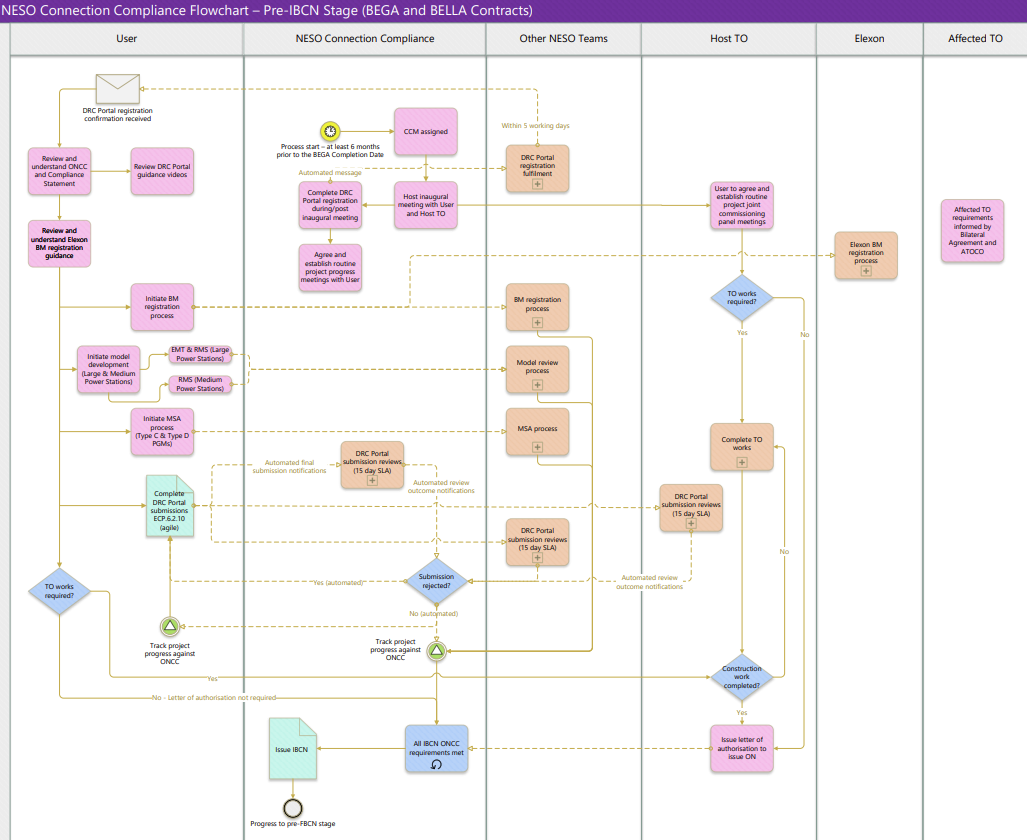
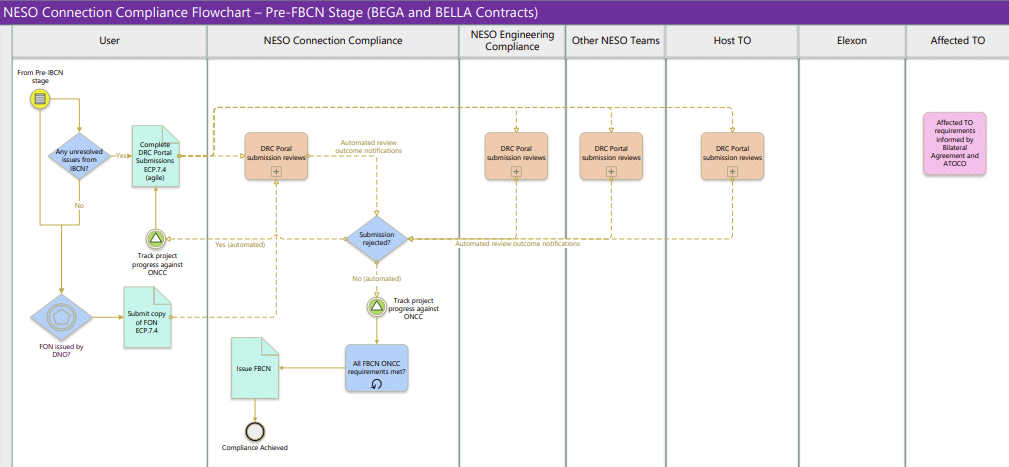
Many activities can run in parallel, please see the compliance flowchart for how these stages interact and where dependencies apply.
- BEGA Agreement – Establishes your contractual relationship with NESO
- Compliance – Demonstrates your plant can operate safely within the system and modelled accurately by NESO
- Operational Readiness – Includes metering, communications and data transfer
- BM Unit Registration – Registers your asset for dispatch and settlement
Indirect Options (Third Party (Option 2) / Aggregator (Option 3))
Typical journey
- Connection (DNO)
- Contract with provider
- Technical onboarding
- BM participation via the provider
What really drives BEGA compliance timescales?
Timescales will vary depending on your specific circumstances, including:
- Your Power Station size, Power Generating Module type(s) and connection arrangement
- The completeness of your BEGA application and compliance submissions (where applicable)
- Dependencies on other organisations (supply chain, contractors etc)
- How you manage dependencies and parallel activities
- Timely and agile submissions of compliance data (not leaving it to the last minute to allow sufficient time for review/feedback/resubmission)
Critical Path vs Parallel Activities (what not to delay)
Customers often assume that everything must happen in sequence. In reality, many steps can run in parallel see our compliance flow chart.
You CAN start these before a BEGA is counter signed:
- Technical compliance activities
- RMS and EMT model development
- Metering procurement and installation
- Options-to-Market discussions (choosing and setting up how you will access the BM, including working with suppliers or aggregators where relevant)
- BM design discussions (defining how your asset will be set up and operated within the BM, including BM Units, communications, and data flows)
- Communication setup
Typically required before BM participation:
- BEGA contract (counter signed)
- Compliance submission acceptance – issue of Interim Balancing Compliance Notification (IBCN) (see Technical Compliance)
- Metering installed and registered
- Communications tested
- SORT upload completed
You can start preparing for BM participation before your BEGA is complete, as progressing activities in parallel is essential to reducing timescales and ensuring a smooth route to market. Please use our SORT process flow chart to better understand the sequence of activities, key handoffs between organisations, and where you can take early action.
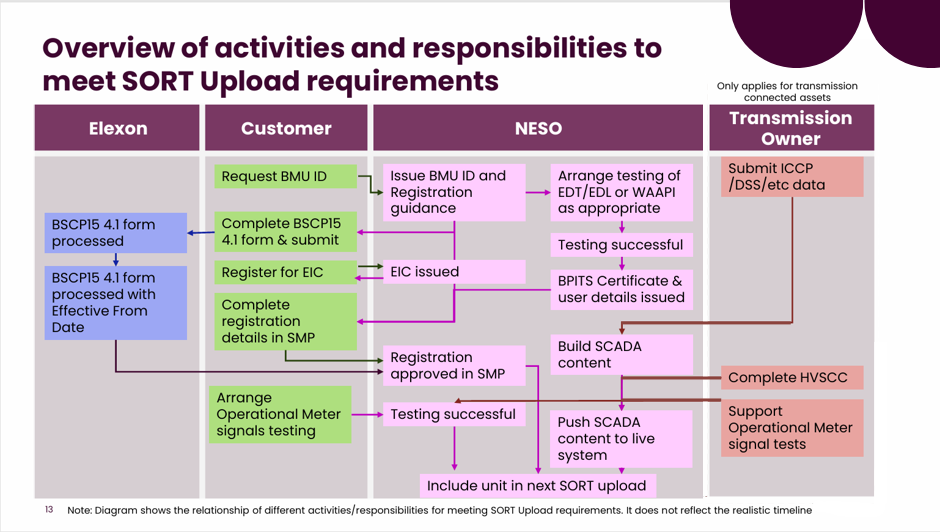
Expand our SORT process flow chart
Why this matters: Understanding what can run in parallel can significantly reduce time to market.
BEGA Grid Code Compliance Journey
NESO compliance focuses on system operation, not just connection. Requirements are defined by the Power Station size (Large, Medium, Small) and Power Generating Module Type (A, B, C, D).
Typical requirements include but are not limited to:
- Single line diagrams
- Protection settings
- Plant data and operating limits
- RMS and EMT dynamic models (where applicable)
- Controller settings
- Compliance Process
Key Point: Even if you have provided similar information to the DNO, NESO still require an independent submission to ensure the plant response can be modelled accurately to ensure system security and economic operation.
Balancing Mechanism (BM) Registration Journey
Before you can participate in the Balancing Mechanism (BM), your asset must be registered so it can be dispatched and settled correctly. To start, you will need to apply through Balancing Mechanism Wider Access (BMWA) using the Single Markets Platform (SMP). BMWA makes it easier for new and existing providers to access the BM and participate in the market.
Using the Single Markets Platform, you will:
- Create your account
- Submit your application
- Manage your onboarding process
Register a Single Markets Platform (SMP) Account
Note: If you are working with a supplier (option 2) or aggregator (option 3), they may complete this step on your behalf.
What this step Involves
BM Registration:
- Enables NESO to send instructions to your asset
- Defines how your asset operates in the BM
- Ensures that you are paid correctly for your actions
What you need to do
Set up how you will participate
Confirm if you are participating:
- Directly (Option 1)
- Through a supplier (Option 2)
- Through an aggregator (Option 3)
Define your BM Units
- Decide how your asset will be structured in the BM
- Group assets into “BM Units” (how the system sees your plant)
Submit your registration data
Provide or confirm via your provider:
- Asset details and location
- Metering arrangements
- Operational characteristics
- Party roles and responsibilities
Tip: Incomplete or inconsistent data is a common cause of delays
Set up metering and communications
- Install and register compliant metering
- Set up systems for:
- Sending data
- Receiving dispatch instructions
- Complete required testing
Complete testing and validation
- Confirm data flows correctly
- Ensure systems align across parties (NESO, Elexon, third parties)
- Demonstrate your asset responds as expected
Go live
Once approved:
- Your BM Unit is registered
- You can receive dispatch instructions
- You can start participating in the BM
Key Points
- Elexon manages registration and settlement
- NESO supports operational setup
- Many steps can run in parallel with compliance and readiness activities
Common Pitfalls (what slows customers down)
- Waiting for BEGA before starting other activities
- Assuming connection = BM readiness
- Submitting incomplete or inconsistent data
- Late or delayed submissions
- Not understanding compliance requirements
- Lack of coordination across parties (e.g. DNO, NESO, Elexon)
- Delays in uploading required documentation (e.g. SORT submissions where applicable)
Roles and Responsibilities
You (the customer):
- Read, understand, and deliver to the obligations contained within your CUSC contract
- Provide complete and accurate information in a timely and agile manner
- Meet technical and compliance requirements
- Manage third parties
- Track and progress your application
NESO:
- Assess applications
- Define requirements
- Provide guidance on what is required and acceptance criteria
- Coordinate NESO processes
- Help identify dependencies and next steps
Other Organisations:
- DNOs – Embedded Network Connection
- Elexon – BM registration and settlement
How NESO can help
If you:
- Have a connection agreement with NESO
- Have a commissioned asset
- Have completed or are progressing G99 compliance with your DNO
- Are considering your route to market
NESO can:
- Confirm whether a BEGA is required
- Help you navigate applicable requirements set out in the Grid Code and related documentation. (You remain responsible for meeting those requirements in full)
- Identify your critical path
- Highlight what can run in parallel
- Coordinate your next steps across organisations
Not sure where to start?
It helps to know:
- Are you already connected?
- The size and type of your Power Station and Power Generating Module(s)
- Do you want direct BM participation?
- Do you need a TEC?
- Will you use a third party?
Need support?
If you have questions about your journey to BM participation or are unsure which team to contact, email [email protected] and we'll help connect you with the right support.
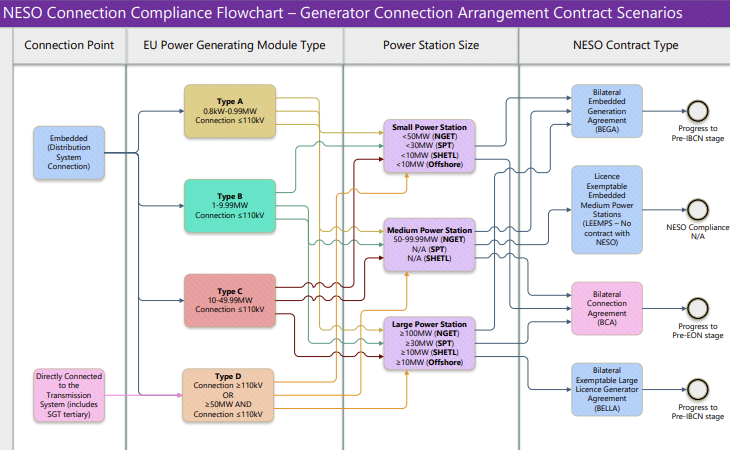
Flowchart coming soon
Flowchart coming soon

We’re improving this journey
This guide is an initial step to make the process clearer and easier to navigate. We will continue to:
- Simplify guidance
- Improve consistency
- Provide clearer timelines
- Enhance support