

System Access Reform
Latest News
- GSR 036 approved by Ofgem - increasing the upper operational pre-fault and post-fault voltage limit for the 200 kV to 300 kV network from +9% to +10%
- Proposed E2E workstream solutions shared with industry, further engagement planned – subscribe today to receive the latest information.
About System Access Reform
As part of a wider UK Government-led programme to support the transformation of the energy system, NESO and the Transmission Owners have been commissioned to assess how the Great Britain transmission system can support a sustained period of network development. Clean Power 2030 (CP30) represents a key milestone within this longer-term transition. A critical enabler of this work is System Access Reform (SAR), which provides a co-ordinated approach to managing network outages required for maintenance activities, new generation connections and essential infrastructure upgrades whilst maintaining security of supply.
To support this, NESO, National Grid Electricity Transmission (NGET, part of National Grid plc), SP Energy Networks (SPEN) and Scottish & Southern Electricity Networks Transmission (SSEN-T) are working together through the SAR programme to deliver a step change in outage planning.
A message from our key sponsors
Collaborating to shape future system access
As sponsors of the System Access Reform (SAR) programme, we are delivering reforms in how system access is planned, co-ordinated and delivered across Great Britain.
Outage planning for new connections, network upgrades and planned maintenance is fundamental to ensuring the system remains safe, resilient and capable of supporting the UK’s Clean Power 2030 ambitions.
The operating landscape is changing rapidly, increasing network investment alongside growing outage volume and complexity means existing approaches will not be sufficient at the scale required.
Through SAR, we are establishing a more coordinated and forward-looking approach - bringing together improved data and insights, reviewing the end-to-end process and developing a clearer, shared view of future outage demand, available capacity, risks and opportunities. We are also progressing targeted improvements, including implementing code modifications recommended in Nick Winser’s independent report and our public consultation in early 2025.
This programme is an enabler for delivering new connections, maintaining and upgrading networks, whilst balancing cost, risk and resilience. We recognise that this transformation cannot be delivered in isolation and continue to engage industry stakeholders at key milestones throughout the programme.
By strengthening collaboration, improving visibility and evolving how system access is planned, SAR is helping to create the conditions needed to support the energy transition.
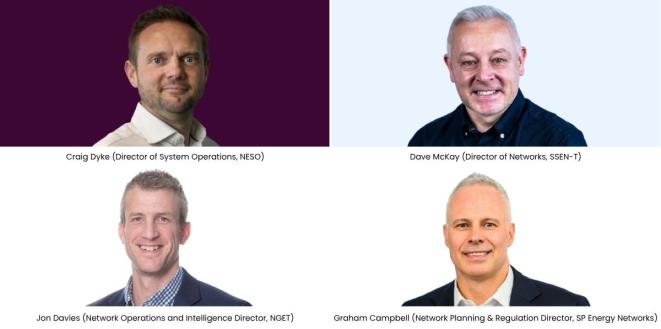
Craig Dyke (System Operations Director, NESO), Dave McKay (Director of Networks, SSEN-T),
Graham Campbell (Network Planning & Regulation Director, SP Energy Networks), Jon Davies (Network Operations and Intelligence Director, NGET)
Case for change
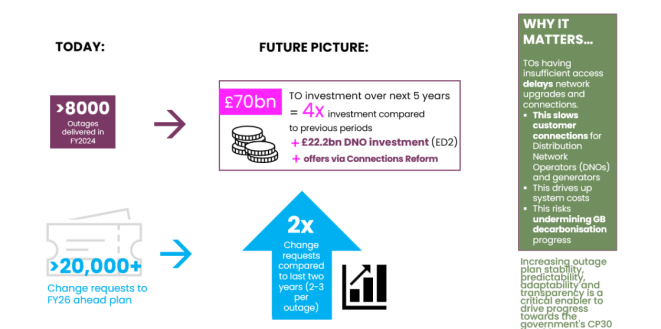
Investment is increasing
- Transmission Owner (TO) investment through RIIO-T3 could reach £70bn.
- Distribution Network Operators (DNOs) are expected to deliver a further £22.2bn through Electricity Distribution Price Control 2 (ED2).
Outage requirements are growing
- More projects, customers and assets are driving increased outage demand.
- Major delivery programmes require more complex outage planning.
Industry must adapt
- Rising change requests are increasing effort and costs.
- NESO and industry participants must work together to maximise outage value while maintaining system operability.
Working in partnership
Graham Stein

SAR Programme Director - NESO
“We see a considerable opportunity to improve visibility, tackle long‑standing pain points and develop a system access process that reflects the scale and pace now required. Delivering this depends on strong partnership with the transmission owners.”
John Wilson

Senior Programme Lead - NGET
“We have a major programme of build and maintenance ahead, requiring more and increasingly complex system access. As we connect strategic demand and support economic growth, maintaining network resilience remains essential.”
Martin Cammidge

Senior Programme Lead - SP Energy Networks
“Nothing is broken today - system access works well. But from where I sit, the challenge is accelerating. SAR is about getting ready for that and continuing to plan for our network growth and our connecting customers.”
Jim Molley

Senior Programme Lead - SSEN-T
“Though remote, our region spans a quarter of the UK landmass and is a major clean‑energy exporter. We’re key to Clean Power 2030, but the scale ahead means existing processes which have been successful for decades now need to evolve.”
Our programme
The System Access Reform (SAR) programme has been set up to transform the way the current processes for requesting system access operate, and has been split into three main focus areas of work - please click on the tabs below to find out more. You can also view our recent highlights too.
1. Deliver commitments
Deliver the commitments made under the Transmission Acceleration Action Plan (TAP), initially set out in the Winser Review. The recommendations were consulted on with industry and endorsed by government.
The team leading this work is progressing a range of initiatives, including System Operator Transmission Owner Code Procedures (STCP) code modifications, a review of the Security and Quality of Supply Standard (SQSS) and other targeted improvements. Proposed changes are being developed and consulted on through the appropriate industry panels, with public consultations undertaken where required. Find out more about industry code modifications (specifically GSR035 and GSR036) here, and read the announcement confirming the approval of GSR036 (October 2026).
The programme has been designed to deliver benefits as early as possible, maximising value quickly. Progress is already being delivered across several areas (please see the Progress tab for more details).
2. Build longer-term visibility
Current outage visibility can be insufficient to support effective long-term access planning. This workstream is focused on using available data and processes to provide earlier visibility of future outage requirements through a co-ordinated six-year planning horizon to help industry stakeholders plan more effectively.
3. Undertake End-to-End Review
The End-to-End review will focus on improved planning stability, increased transparency, strengthened governance and decision-making, and enable a more co-ordinated approach to outage planning across the GB electricity transmission network. Via a portfolio of solutions, the review will seek to improve visibility of network access plans, increase network access availability, reduce planning conflicts and support strategic objectives including UK energy security, Clean Power 2030 and Net Zero 2050.
To achieve this, the project is taking an evidence-based approach, combining stakeholder engagement, process mapping, root cause analysis and data analytics to identify barriers across planning, governance, data, tooling and ways of working. Alongside this, practical improvements are being introduced where possible - this includes an interim escalation framework to deliver early benefits and support more effective outage prioritisation.
The review will consider current interactions between NESO, TOs, DNOs and generators, strengthening collaboration, alignment and coordination to support more effective system access planning across the industry.
Latest progress
20% increase in work (OP1) More outages enabled for 2025/26 compared to the previous winter due to successful trialling of new processes across the year. | Code modifications in progress (OP2) SQSS GSR 035 (Currently in workgroup stage) - Review of the operational requirements on the onshore Transmission Systems. |
Costs included in planning (OP3) System Access costs now included in strategic planning to allow for system access to be factored into TO design work. | Code modifications approved (OP1/OP3) STCP-11-1 will extend winter emergency return to service times. |
Readiness checks and testing (OP4) TO project readiness checks and processes are well underway, and testing of outage optimization tools are in progress. | NESO Business Readiness Currently in process of engaging with teams in scope of the STCP & SQSS changes to be implemented. |
Improving long-term visibility Regular engagement with DESNZ and Ofgem is underway to share the current outlook and provide greater long-term visibility. The team is also supporting planned actions and transitioning key processes into business-as-usual activities. | End-to-End transformation taking off and engaging with key stakeholders The team is assembled and we have completed a discovery activity to understand the to-be model with the ‘to-be’ picture design currently in progress (target: early autumn 2026). We have also completed iterative improvements such as implementation of an interim escalation framework. Following initial engagement during the programme launch phase, active engagement with Distribution Network Operators (DNOs) and generators / customers is ongoing, with wider industry engagement scheduled for the coming months. |
Last update: August 2026
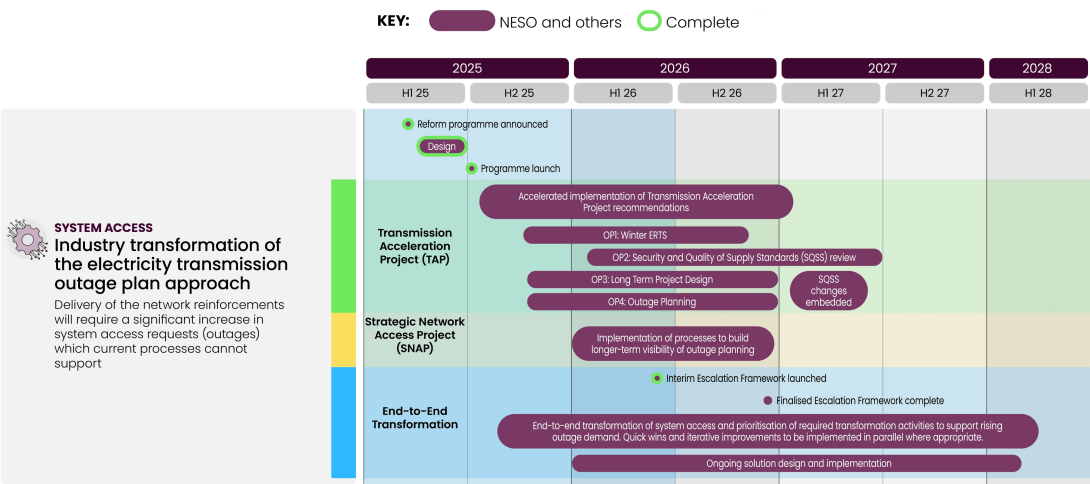
Programme Plan
Supporting Information
Webinar to the Industry: System Access Reform Programme
| Document title | Published date |
|---|---|
| About System Access Reform (SAR) | August 2026 |
| A credible pathway to delivery (SNAP) | September 2026 |
| Industry code modifications - SQSS (TAP) | October 2026 |
Get in touch
This is an exciting time for System Access. If you'd like to be involved in focus groups or learn more about how it will set a new standard for efficiency, co-ordination and transparency, please contact us.