

Winter Watch
NESO has published its Winter Outlook for 2026/27, setting out its latest view of how Britain’s electricity system is expected to operate over the coming winter.
Britain’s electricity supplies expected to remain secure this winter
Building on our Early View of Winter Outlook published in June 2026, our outlook remains largely unchanged, with enough electricity supplies to meet demand throughout the winter.
This report provides a more detailed assessment of the winter ahead. The reported margin is higher than in our June outlook but this is due to improvements in the assessment methodology, not a change in the overall outlook. For a complete picture, this report should be read alongside National Gas's Winter Outlook 2026/27.
Testing 30,000 winter scenarios
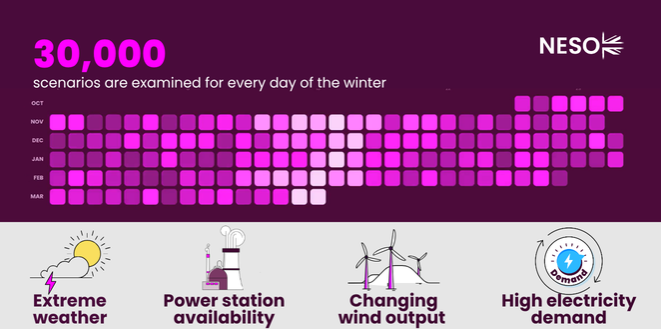
To help understand how the electricity system could perform this winter, we test 30,000 scenarios that explore a range of possible conditions, from cold, still days with high electricity demand to milder, windier periods with more renewable generation. They also consider power station availability and electricity imports. By examining thousands of potential outcomes, we can build a complete picture of the risks and uncertainties ahead and help ensure the system is prepared for a wide range of winter conditions.

Download the 2026 Winter Outlook
Please note that a revision was made to the Winter Outlook report on 27 October 2026. More details can be found in our Table of Corrections on page 30.
We welcome feedback on how the Winter Outlook can continue to support industry planning.
Feedback can be sent to [email protected], discussed through the Operational Transparency Forum, or shared via @NESO_energy.
What are electricity margins?
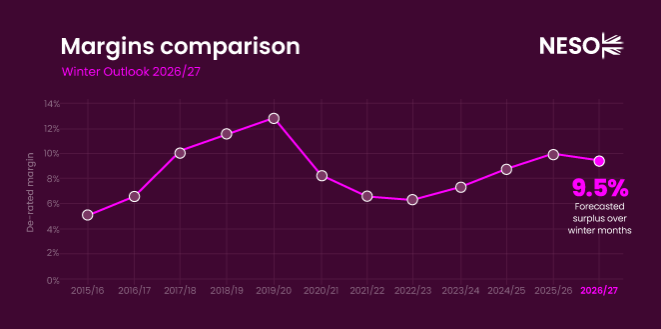
We expect a margin of 5.9 GW this winter, equivalent to around 9.5% above peak demand. This is the buffer between the electricity expected to be available and what Britain is expected to need at peak times.
Additional battery storage, wind generation and gas-fired power are helping maintain healthy margins, broadly in line with recent winters.
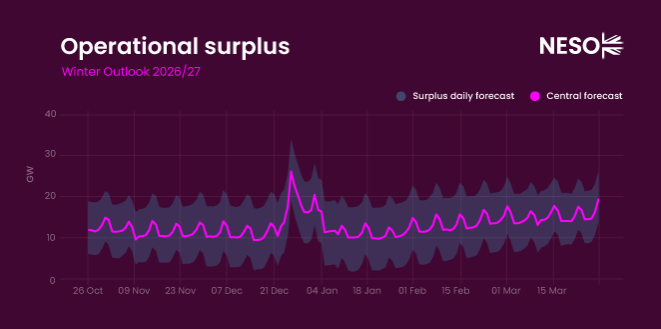
Explaining operational surplus
Operational surplus is the electricity available after forecast demand and reserve requirements have been met.
Our modelling shows sufficient operational surplus throughout winter, although some days may be tighter than others. We continually monitor conditions and have a range of established operational tools available to help maintain a secure and reliable electricity system.
Frequently Asked Questions
Our Winter Outlook shows that Great Britain’s electricity supply is expected to remain within the Reliability Standard set by government. We expect supply margins to be similar to recent winters. Although peak demand is expected to rise, this is largely balanced by new capacity from a range of technologies.
We plan for a wide range of possible conditions and work closely with government, Ofgem, the Met Office, National Gas, network companies, industry and international partners. We also monitor markets and weather forecasts, coordinate emergency planning and make sure our operational tools are ready.
We are not forecasting blackouts. As in any winter, there may be days when supply margins are tighter. If this happens, we can use our usual operational tools to help balance the system and keep electricity flowing reliably to homes and businesses.
A tight day is one when less spare electricity is available than usual. It does not mean there is too little electricity to meet demand.
We may issue a notice asking the electricity market to make more power available. This helps us build a larger reserve. These notices are a normal part of operating the electricity system, and we prepare for them every winter.
Electricity imported from neighbouring countries is one part of Great Britain’s diverse supply. Our analysis indicates that imports should be available when needed. We work with electricity system operators in neighbouring countries to manage power moving between connected electricity systems.
Great Britain’s electricity system is secure, resilient and well prepared for winter. Our assessment shows that there should be enough electricity to meet demand. We also have established tools and plans ready to manage periods when supply margins are tighter.
Key terms:
- De‑rated margin: The expected spare electricity available over winter, adjusted to reflect how reliably different types of generation are likely to be available.
- Operational surplus: A day‑to‑day view of spare electricity, showing when tighter days could happen.
- LOLE (risk measure): A risk measure that helps assess how often supply could fall short. This is normally managed through operational actions without affecting customers.
- Interconnectors: Links to other countries that let us import or export electricity when needed.
National Gas Winter Outlook

NESO only assesses requirements on the electricity network. Find more information about the gas network on the National Gas website.
Winter Operations

Here you can view all past Winter Outlook reports and all policy documentation relating to Winter Operations.
Future of Energy updates

Subscribe to our mailing list and we'll let you know as soon as we publish any of our future of energy documents.