
Data Sharing Infrastructure (DSI)
The Data Sharing Infrastructure (DSI) is a socio-technical solution that makes it easier for the energy sector to share data and models in a scalable, secure, and resilient way by bringing together common processes, governance, and technology.
As publicly-owned digital infrastructure, it plays a crucial role in the sector’s digitalisation and enabling clean power by 2030.
How to get involved
The DSI is a common, publicly-owned digital infrastructure for the benefit of all, designed to be inclusive, adaptable, and scalable, setting a new approach for delivering public digital infrastructure at scale and pace within the energy sector.
Engagement is open and organisations can join as active participants or just stay informed by subscribing to the NESO external newsletter and selecting “Virtual Energy System” (VirtualES) from the list. If you’re interested in getting involved, please contact [email protected] or take a look at the shared knowledge base.

Why does the DSI exist?
For years, the energy sector has recognised the need for better ways to share data, which often can be slow and complex, usually relying on a web of bilateral contracts and custom integrations. The main reason is the ‘handshake problem’: as more organisations want to share more data, the number of technical connections and legal agreements grows almost exponentially.
The DSI aims to solve this problem. It provides a common approach that makes it easier for any energy sector participant to share data with any other, securely and efficiently.
The journey so far
The concept of the DSI emerged from years of groundwork, including the Digital Spine Feasibility Study (2024), and recommendations from the Energy Digitalisation Taskforce. Initially referred to as the “digital spine”, the terminology evolved to “Data Sharing Infrastructure” to better reflect its purpose: providing the foundational publicly-owned digital infrastructure for secure, trusted data exchange across the sector.
The DSI is also referenced in major government strategies and reports, including most recently the UK Industrial Strategy (2025). Following formal mandates from government and Ofgem, NESO has taken on the development, delivery, coordination, and governance of the DSI on behalf of and in collaboration with the sector, ensuring the solution meets its needs.
Core Components
A lightweight, open-source technology that sits at the boundary of each organisation participating in the DSI. It acts as a secure gateway into the trusted ecosystem, providing the minimum necessary functionality to connect, discover, and share data.
The node is designed to be modular, so organisations can deploy the full functionality or integrate just the essential elements with their existing IT systems. This ensures the DSI is accessible to organisations of all sizes and technical capabilities.
The control plane or broker at the centre of the DSI ecosystem, the DSM includes a central metadata catalogue for data discovery. It manages authentication and authorisation, ensuring only the right organisations and individuals can access data. No data is stored centrally in the DSM; all exchanges are peer-to-peer between nodes, governed by robust security and trust services.
Across the DSI is embedded the Trust Framework, a scalable legal and technical framework that rationalises the effort needed on contracting, connections and coordination to share data. Instead of hundreds of bespoke agreements, organisations can rely on standardised, machine-readable arrangements that make data sharing faster and more secure.
The DSI focuses on both open and shared data, as defined in the Open Data Institute’s Data Spectrum. It is designed for any energy sector participant, from regulated networks and system users to SMEs and researchers. It will enable connectivity for many-to-many relationships and with time frequent or even live data exchanges through APIs and streaming integration patterns.
The DSI provides secure data sharing mechanisms and incorporates existing data models and protocols. However, it does not manage or ensure the quality of data within organisations.
Organisations deploy their DPNs, connect them to their internal data sources, and register with the DSM.
When one organisation wants data from another, it searches the central metadata catalogue, requests access, and, if authorised, receives the necessary certificates to exchange data securely.
All transactions are peer-to-peer, with no data passing through the DSM. This approach supports many-to-many connectivity, enabling the sector to scale data sharing as needed. It also allows organisations to focus on delivering value through their use cases, rather than building their own technical and legal exchange mechanisms.
NESO is accountable for developing and operating the DSI, including the DSM and DPN, and the trust framework detailing obligations and rules of usage.
Our role as Interim DSI Coordinator involves providing governance, oversight, and coordination, progressing DSI development and service delivery on behalf of and in collaboration with the sector.
Principles and values
The DSI is built on key principles:
General principles
- Organisational ownership: Each participating organisation retains full ownership, responsibility, and control over the data it shares, including how and under what conditions it is made available through the DSI.
- Self-service enablement: Empower organisations with self-service capabilities to participate in the DSI; whilst ensuring adherence to policy and alignment to key standards and protocols. This includes the ability to publish, discover, access, and monitor data in a secure, policy-aligned, and streamlined manner.
- Federated computational governance: The DSI will implement a federated computational governance model, where global policies for data sharing are automated and enforced (by the DSM).
- Low barrier to adoption: The DSI must be easy to adopt and use across a range of organisational and technical contexts, minimising the need for deep technical integration or specialised expertise.
- Prioritise user needs: The DSI will evolve through an approach of gathering specific needs by working with the sector on defined use cases that helps drive prioritisation and implementation of requirements. A clearly defined core set of capabilities will be developed and maintained to support reuse, interoperability, and scalability across multiple use cases.
Data principles
- Make data FAIR: Data shared through the DSI must be Findable, Accessible, Interoperable, and Reusable (FAIR) across different systems and use cases.
- Data-as-a-product: All data that is shared within the DSI will adhere to a set a of usability characteristics to ensure that the data is understandable, secure, trustworthy, and interoperable.
- Alignment with Ofgem Data Best Practice: The DSI will align Ofgem’s Data Best Practice Guidance.
Technology principles
- Use open standards and open source: Adopt open standards and open-source technologies where appropriate, to ensure interoperability.
- Modularity and Optionality: The DSI will be architected as a modular system, allowing participants to adopt only the functionalities relevant to their needs and roles. This approach ensures that participants can enter, scale, or innovate within the DSI ecosystem without being locked into monolithic or prescriptive architectures.
Security principles
- Operate under a Zero Trust Architecture: The DSI will adopt a Zero Trust Architecture (ZTA), based on a “never trust, always verify” approach. This means that every access request to data or services within the DSI must be authenticated, authorised, and continuously validated, regardless of the origin or prior standing of the entity requesting access.
- Alignment with National Cyber Security Centre (NCSC) best practices and guidance: The design of the DSI will adhere to the best practices and guidance issued by the NCSC.
Roadmap and next steps
The DSI delivery is grounded in proven product and service development practices, and follows a lifecycle approach aligned to the Government Digital Service (GDS) Manual: Discovery > Alpha > Beta (Private, Public) > Live.
Each phase is mapped to real-world data products, with scale and complexity growing as requirements evolve.
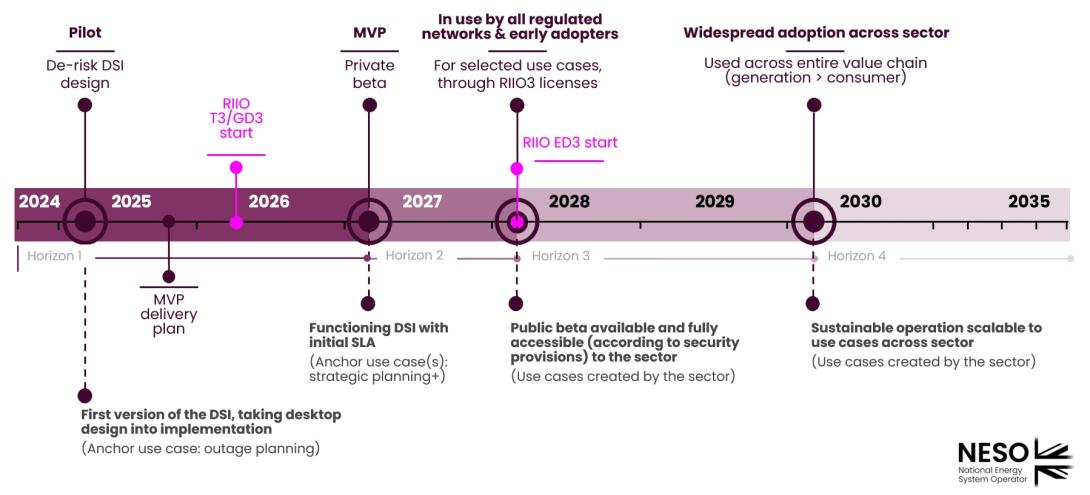
In the MVP phase we are focussing on the regulated networks but would also like to invite any "digitally-ready" organisations who are able to deploy and participate at pace.
Public Beta and full live releases are planned for 2028–2030, with NESO coordinating requirements and prioritising functionality for high-value use cases, whereby any energy participant will be able to share any data in a trusted, secure and seamless way.
Documents and resources
Documents
Recordings
DSI Pilot Show & Tell - May 2025 - Watch webinar
DSI Industry webinar - December 2025 - Watch webinar
DSI Industry webinar - May 2026 - Watch webinar
DSI Industry webinar - September 2026 - Watch webinar