Energy Explained
Strategic Energy Planning changes: a first for Great Britain
13 Feb 2026 - 5 minute read
Great Britain’s energy system is going through its biggest transformation in a century. The UK…


Craig Dyke, Director of System Operations at the National Energy System Operator, sets out how managing the impact of the autumn clock change is all in a (25 hour) day’s work for his team of engineers.
This Sunday (26 October) at 2am, clocks across Great Britain go back an hour for daylight saving time.
For most Brits, the darker evenings mark a transition to winter habits and a need to manually change the clock on all manner of in-home devices. It can also mean an extra hour of sleep, accidental early arrival to appointments, and an autumn Sunday that feels that little bit longer.
But for the group of highly-skilled power system engineers in the NESO electricity control room, it’s one of the most challenging and exciting moments in the calendar.
The biggest impact on those managing the flow of power minute-by-minute is the change in the time and size of peak demand. Peak electricity demand occurs in the evening, when people return home and switch on lights, appliances, and heating.
When the clocks go back, this brings forward the time that street lighting illuminates and households and businesses need to switch on lights in the evening. This additional lighting activity increases the size and time of that evening peak, resulting in what we call the Darkness Peak profile.
Overall, the evening peak grows by around 4GW, roughly the output of four large power stations. This increase will be most visible on Monday 27 October when workplaces add to overall demand. The orange line on the graph below shows how peak demand effectively came forward an hour on the Monday after the clock change this time last year (October 2024).
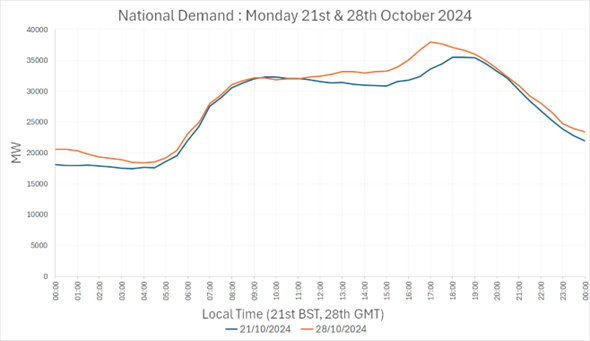
Using data from previous years and our sophisticated forecasting tools, we can predict what this new peak might look like and ensure we have got more than enough electricity generation on the system to manage it. In fact, preparation for the clock change started way back in July, when we start to look at it in our 13 week ahead demand forecast models.
One short-term relief the clock change brings is lighter mornings, at least for a few weeks as we count down to the shortest day of the year on 21 December. This helps to smooth out the morning peak as initially, some will reduce use of lighting in the morning, before they head off to work or out to walk the dog.
Although psychologically it might feel like winter has arrived, the clock change doesn’t mean it suddenly gets colder. Renewable sources like solar can still provide significant contributions to meet demand, all that changes is the profile of when that generation is available. For example, some of the demand increase at evening peak is as a result of the loss of solar PV production, since it inow dark at that time of day.
We have a number of tools and options available to keep the system balanced. Our control engineers will have the most-up-to-date forecasts at their disposal and they will use the suite of Balancing (generation and demand-flex) Services to operate the system in a secure and economic manner.
For many of our shift workers in the control room, and many others across all industries, the autumn clock change means an extra hour at work rather than an extra hour of bed! Of course, this gets balanced out when the clocks go forward again in spring though, if you happen to be on shift again!
The clock change in Great Britain has a range of impacts on the electricity system, affecting demand patterns, generation, and system operation.
While the system is resilient and our team of expert engineers is well-prepared for these seasonal changes, this is a significant moment that needs careful management. Enjoy your extra hour in bed.