
Security of Supply
NESO ready for record electricity demand during biggest…
8 Jun 2026 - 4 minute read
As football fans across Great Britain gear up to cheer on England and Scotland in the 2026 FIFA…


During the week commencing Monday 22 June, extreme heat affected Great Britain and Europe. The Met Office issued a red weather warning, advising of dangerous conditions with a risk to life and significant disruption to travel and energy supplies. [1]
These conditions placed sustained pressure on power systems and created tight operating margins across Great Britain and Europe.
Despite this, no customer demand was disconnected, frequency remained within statutory limits, the voltage stayed within limits and no lines or cables were overloaded.
A combination of low wind, reduced gas generation availability, high sustained demand, adverse interconnector flows and network constraints created a complex operational challenge. The Electricity National Control Room (ENCC) managed this in real time through market engagement, use of demand flexibility, deployment of reserve, trading with neighbouring system operators and instructions to interconnectors.
At times, frequency moved outside the normal operating range. This is expected under stressed conditions and it remained within statutory limits of 49.5Hz to 50.5Hz at all times (see note below on frequency standards).
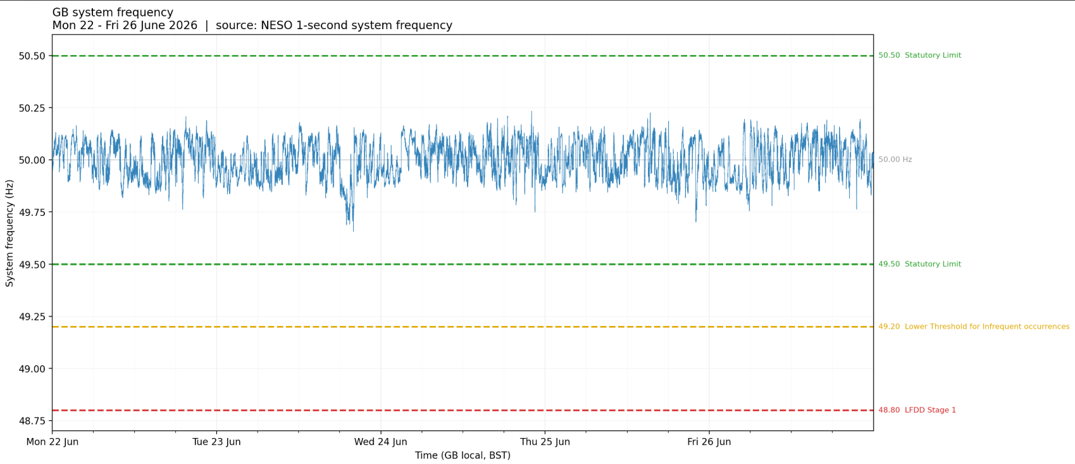
The chart below shows the frequency trace from Monday 22 June to Friday 26 June, using 1-second data. The full dataset will be published on our Data Portal. [2]
Across the period, frequency remained stable. The lowest recorded value was 49.66Hz and the highest was 50.23Hz. Even at its lowest point, frequency stayed above the statutory lower limit of 49.5Hz and well above the level at which customer disconnections could occur (48.8Hz).
We are now analysing system and market performance during this period, as we do after all major events. We will share our findings and engage with stakeholders through our Operational Transparency Forum and other channels.
Frequency on Great Britain’s electricity system is governed by the Security and Quality of Supply Standard (SQSS) [3] and the Frequency Risk and Control Report (FRCR). [4]
These require that steady-state frequency remains within statutory limits of 49.5Hz to 50.5Hz. Following any credible loss event, such as the disconnection of a generator or interconnector, frequency deviation should be maintained within 49.2Hz to 50.5Hz.
The ‘normal operating range’ of 49.8Hz to 50.2Hz is an internal NESO operational guideline for routine conditions. It does not form part of the statutory requirements set out in SQSS or FRCR.